Mystery Worshipper: Cool Dude
Church:
St Magnus the Martyr & Southwark Cathedral, London Bridge
Location: London, England
Date of visit: Sunday, 11 January 2026, 12:30pm
The building
London Bridge has been a crossing point since Roman times and it is no exaggeration to say that London owes its site to the fact. The present structure dates from 1971. Standing in the middle of London Bridge one can easily see the two churches participating in this ceremony: the square gothic tower of the cathedral to the south and the Baroque spire of St Magnus, designed by Christopher Wren, to the north.
The church
The two churches taking part are rather different. St Magnus is a parish church that was once a bridge chapel for travellers arriving in, or leaving, the capital city. It is known today as a bastion of liturgical tradition. Southwark Cathedral is the mother church of London south of the Thames, in the separate diocese of Southwark since 1905, and has developed a reputation for social engagement. Beyond this ceremony I wondered what contact the two worshipping communities have from day to day.
The neighborhood
London Bridge offers views up and down the Thames, and the wide expanse of the river is typically brown and sullen, especially under a winter sky. But in its timelessness, the river is a reassuring presence for Londoners. Every Londoner has a secure sense of whether they live north or south of the river, and near to it or at some distance.
The cast
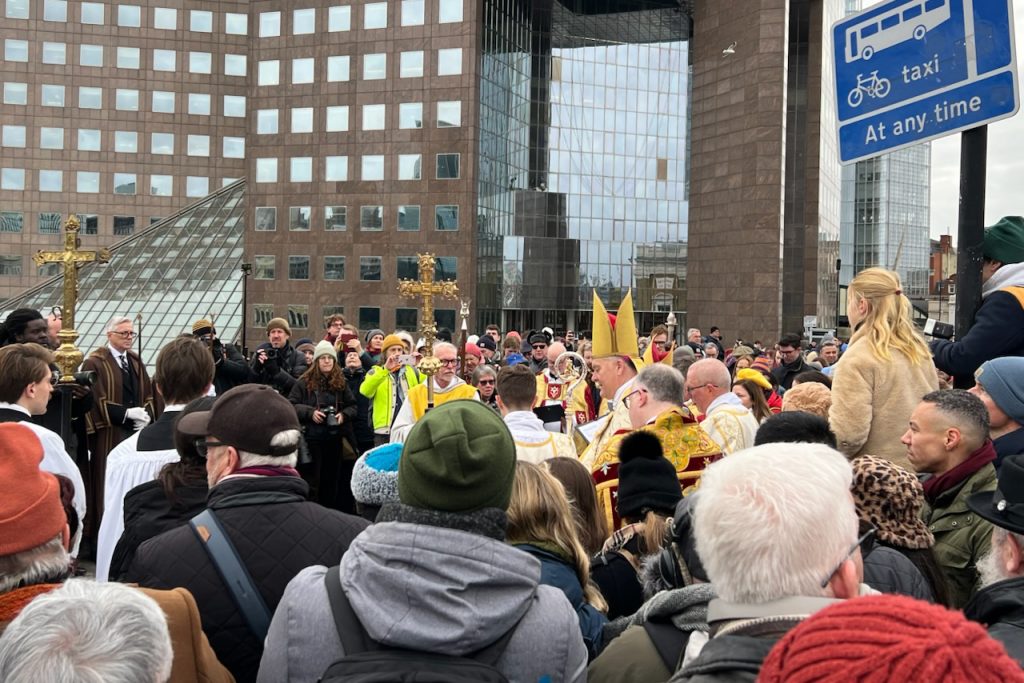
The cast was extensive. From the Southwark side, there was the Bishop of Southwark, the Dean of Southwark Cathedral, and a posse of chaplains, acolytes and followers from the congregation. From north of the river was the Bishop of Fulham, the Rector of St Magnus (who styles himself ‘cardinal rector’), and their vested priests and acolytes.
What was the name of the service?
The Blessing of the River Thames, on the Feast of the Baptism of our Lord.How full was the building?
One part of the congregation processed from Southwark Cathedral on the south bank of the river and the other from St Magnus the Martyr on the north bank. Once we met in the middle of the bridge, I estimate there were 300 or so. How many had gone there intentionally and how many were bemused tourists who happened upon the ceremony by chance is difficult to say. During the proceedings we probably picked up another 100 onlookers.
Did anyone welcome you personally?
A steward wearing a Southwark Cathedral high-vis tabard was handing out orders of service.
Was your pew comfortable?
We all stood, and gave thanks that the weather was more or less friendly.
How would you describe the pre-service atmosphere?
Some looked perplexed but interested at what was going on – these were presumably the tourists who had accidentally happened on the ceremony. Others waited in hushed attendance as though they knew why they were there. Many – your Mystery Worshipper among them – lifted phones aloft to snap a photo of what was happening at the centre of things, as its was difficult to see.
What were the exact opening words of the service?
According to the order of service it was ‘In the name of the Father...’ just like many indoor services.
What books did the congregation use during the service?
Everything we needed was in the order of service. Thank goodness I had been given one, for without it I would not have had any idea what was happening.
What musical instruments were played?
None. As far as I could tell the service was said, not chanted. The bells of both Southwark Cathedral and St Magnus were being rung expertly and at pace throughout proceedings. I love the joyous sound of English change ringing, but the effect in the middle of the bridge of both ringing at once made the ceremony even less audible.
Did anything distract you?
A significant number of pedestrians encountered the crowd and pushed through, some agressively and making disparaging comments as they went, resenting the obstruction of their pedestrian route. I suppose if they were going somewhere, they had a point, though their lack of grace was regrettable. Some of the Southwark Cathedral stewards in tabards were ushering them past the crowd, and that mostly worked. That, plus the traffic thundering by close-to, and the ringing bells, was a pretty distracting mix.
Was the worship stiff-upper-lip, happy clappy, or what?
The bishops wore a tall mitres (thankfully it was not windy), and there were lavish gold vestments for both parties. There was a certain amount of competitive solemnity going on, with the cathedral having the edge on numbers in their procession, but St Magnus was the narrow overall winner because of the very high gold thread count on their vestments. Croziers and staffs of office were carried, and what a fine collection there were. Acolytes showed a saucy amount of lace on surplices. There were three readings and a Psalm (46), all of which featured references to the life-giving qualities of water and rivers, the latter more obviously as a symbol of spiritual rebirth. The canticle was The Song of Ephrem the Syrian (d. 373), a piece of ancient hymnody new to me, and which also features beautiful water imagery. Readings were carefully shared out between the two parties. A lot of thought had gone into the service, and it would have been nice to hear at least some of it, and join in the responses.
Exactly how long was the sermon?
There was no sermon.
Which part of the service was like being in heaven?
At the climax of the service, the Bishop of Southwark blessed the River Thames, and the Bishop of Fulham cast a wooden cross into the river. The order of service noted he would do this ‘when it is safe to do so’, presumably when he could see no vessels passing below. The cross was swiftly swept away by the river, a nice reminder of our temporality and, more prosaically, of the force of a moving body of water. I have lingering doubts about the theology of blessing a river. I mean, exactly what is our petition for the river?
And which part was like being in... er... the other place?
From the order of service, this was a solemn and dignified ceremony of blessing, but, in common with large numbers of those present I did not hear a single word. Now that busking musicians, mass roller skate gatherings, and street vendors, among others, have perfected the battery operated portable sound system, it seems a pity that one was not available for this.
What happened when you hung around after the service looking lost?
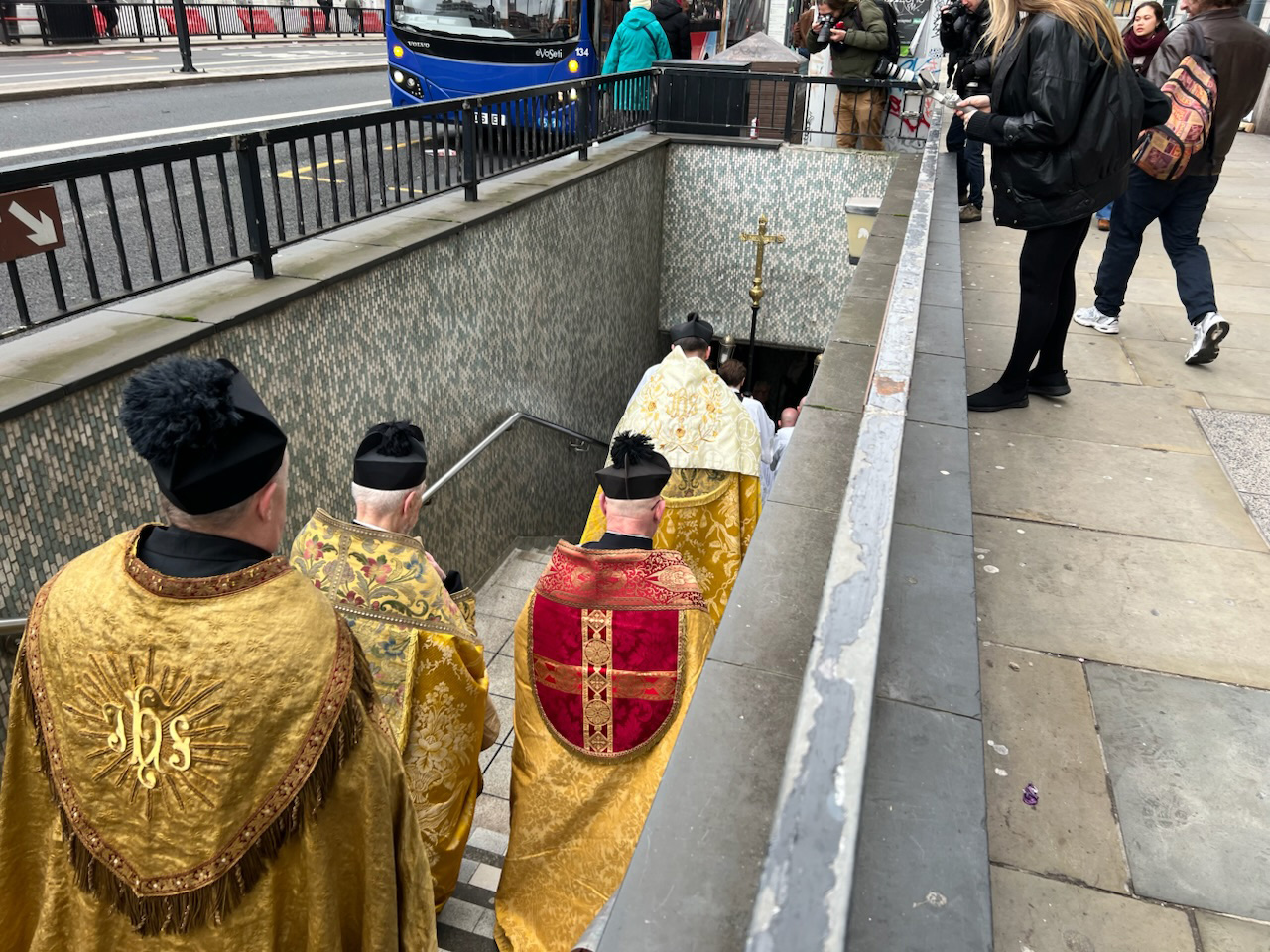
After the blessing and dismissal, the two church parties executed expert u-turns and processed back to their respective churches as a recessional would in a church. A whole new batch of tourists were amazed at the sight. Having arrived with the Southwark posse, I though I should leave with the north-bankers from St Magnus, to keep with the evenhanded spirit of the occasion. Many others did so, before dissolving into the busyness of the city. However, the St Magnus procession had to access their church down a pedestrian underpass at the end of the bridge. This tunnel is narrow, badly lit, not often cleaned and uriniferous. So the sight of the processional cross, gold copes and immaculate white acolyte surplices disappearing into it brought things down to earth with a bang. I didn’t speak to any of the other congregants, and non spoke to me.
How would you describe the after-service coffee?
This seemed to be a non-catered event. If the two churches held receptions afterwards, the general throng were not invited. Not to worry; the area is full of coffee shops for those who needed to warm up or onboard some caffeine.
Did the service make you feel glad to be a Christian?
Possibly.
What one thing will you remember about all this in seven days' time ?
The cluster of gold copes processing into a grotty tunnel. But also a page I didn’t notice in the order of service until I got home. This described the work of Bridge Watch, teams of volunteers who ‘engage or intervene’ with those contemplating suicide here. Sadly, London Bridge is one of two London bridges to which the suicidal are often drawn. Suddenly the sight of the wooden cross being so rapidly swept away in the river current took on new power and meaning. Bridge Watch sounds like a heroic and form of outreach.