Mystery Worshipper: Portola
Church:
St Georgen, Wismar
Location: Germany
Date of visit: Sunday, 3 May 2026, 11:00am
The building
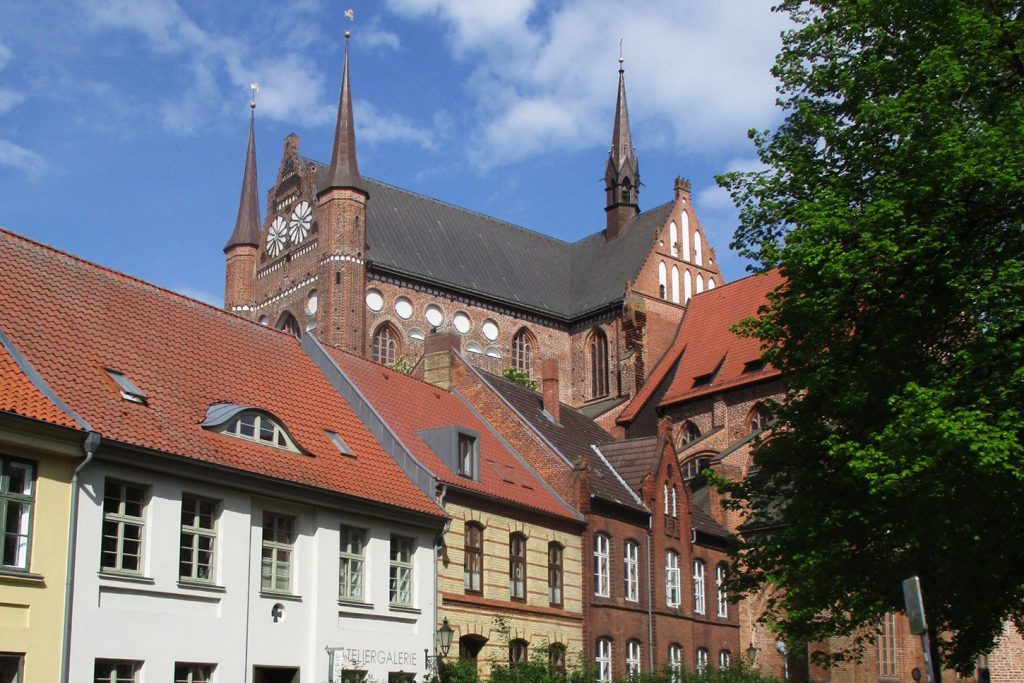
St Georgen (Sankt-Georgen-Kirche) is a brick Gothic structure, a basilica with three naves, begun in 1404 and completed in 1594. Its monumental size is an expression of the wealth of the merchants of the Hanseatic League. But the funding was not sufficient to build a high tower, which is usually part of the makeup of brick Gothic churches. During the Second World War the church was damaged by two bombs. After the war the church could have been rebuilt with relative ease and economy. However, because the East German regime had no interest in restoring it, the church deteriorated and became an ugly ruin. After the reunification of Germany in 1990, a restoration initiative was established and by 2010 the church structure had been restored. This successful reconstruction of a massive, deteriorating ruin has been referred to as ‘the miracle of Wismar’. A popular feature of the church is an elevator to a viewing platform which offers a scenic view of Wismar.
The church
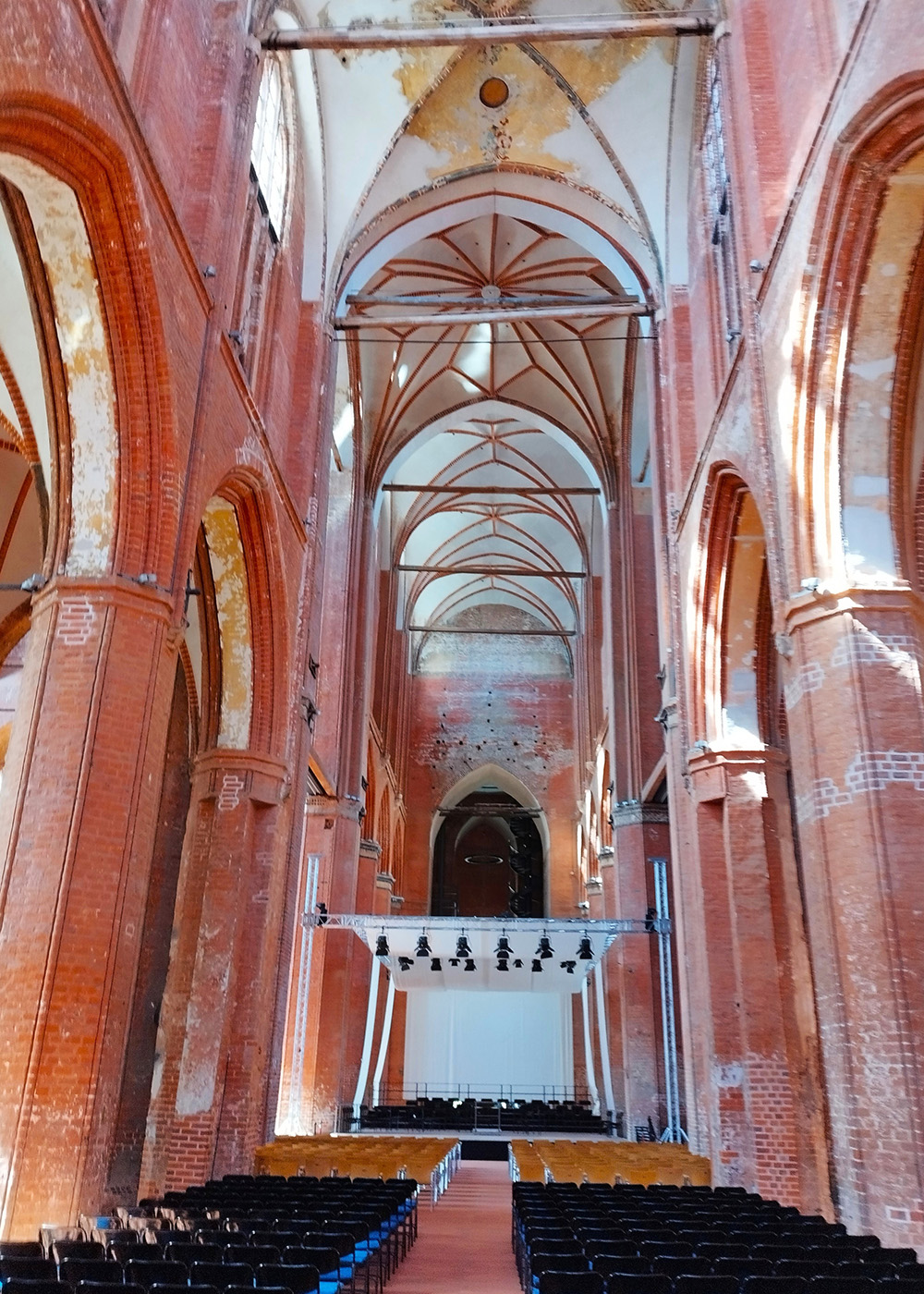
This church is used regularly for morning meditations during the week and occasionally for Sunday worship, as it has no altar and no organ. It is part of the community of the Church in Wismar, which take turns hosting special events. At the front of the nave is a stage which can be used for concerts, theatre performances, movie festivals, conventions, lectures and other cultural events. The unsightly stage, with metal frameworks supporting numerous floodlights, has cloth walls at the back, sides and overhead, which enhance the acoustic. For services, a provisional altar and a lectern are set up on the stage. Some parts of the church are used as storage areas. Otherwise the side naves are empty.
The neighborhood
The Hanseatic City of Wismar was founded in 1226. It is a port city on the Bay of Wismar on the Baltic Sea, and joined the Hanseatic League in 1259. In 1632 it was captured and held by Sweden until 1803. From 1949 to 1990, Wismar was part of the German Democratic Republic. The skyline of the city is still dominated by three monumental brick churches: St Nikolai, St Marien (only the tower survives) and St Georgen. In 2004 Wismar became a UNESCO World Heritage Site because of its picturesque brick Gothic structures and rows of vintage gabled patrician houses.
The cast
A pastor of the Church in Wismar led the liturgy. A retired pastor gave the sermon.
What was the name of the service?
Cantata Worship Service, featuring the JS Bach Cantata, ‘For God so loved the world’ (BWV 68).How full was the building?
The church was full. I estimate 400-500 persons.
Did anyone welcome you personally?
Two people at the entrance greeted the visitors and gave them a program containing all the relevant texts of the service. Since the pandemic, handshake greetings are no longer customary.
Was your pew comfortable?
The chairs were comfortable.
How would you describe the pre-service atmosphere?
Quiet conversation.
What were the exact opening words of the service?
‘Sing to the Lord a new song, for he has done miracles!’ (Psalm 98:1).
What books did the congregation use during the service?
The hymns on the program sheet were from two hymnbooks: the official hymnbook of the Evangelisch-lutherische Kirche der Landeskirche Mecklinburg, and Heaven, Earth, Air and Sea, a supplement to the regular hymnbook of the Northern Church.
What musical instruments were played?
This church has no organ. The hymns were accompanied by keyboard and a small portable pipe organ, which was just barely loud enough to accompany the congregational singing. The choir (Kantorei Wismar), consisting of 22 singers, supported the congregational singing. The Bach cantata was accompanied by an orchestra (Collegium für Alte Musik Vorpommern) which consisted of 16 musicians.
Did anything distract you?
There was a loud chirping of birds trapped inside the church. Also trapped inside the thick brick walls was the arctic chill of winter. It was almost like being inside a refrigerator. An aspect of this service which distracted me is a prayer custom which seems to have become universal in all Protestant churches in Germany, especially when they are televised. In former times, intercession was addressed to ‘eternal God’, ‘almighty God’, ‘gracious Lord’, ‘loving Creator’, ‘heavenly Father’, ‘merciful Redeemer’, ‘our Saviour’. Using a preamble when addressing the divine being was, as I see it, an expression of reverence. However, all divine adjectives have disappeared from intercessions in German Protestant worship. It has become universal practice to begin an intercession with a simple and direct ‘God’ (never ‘Lord’). There is no longer any creativity, emotion or variety in the way in which the divine presence is addressed; all intercessions began with ‘God’, which seems to be the most colourless way of beginning a prayer.
Was the worship stiff-upper-lip, happy clappy, or what?
The service had a formal liturgy, which was reduced in size because of the Bach cantata. The Kyrie was an elaborate composition sung by choir and congregation, featuring texts of Dietrich Bonhoeffer. There was no Gloria in Excelsis, no holy communion, and only one scripture reading, which was also the basis for the sermon. Instead of the Apostles’ Creed there was a ‘Musical Confession of Faith’ – ‘We believe in God, the Creator of sound and music, of vibrations and rhythm, who hums and sings in all living things. We believe in Jesus Christ, in whom God has given his song of love...’ Before the sermon, children were invited to attend a Sunday school in a separate room. Three children participated, accompanied by five adults. As a postlude to the service, the choir sang again the opening chorus of the cantata.
Exactly how long was the sermon?
16 minutes.
On a scale of 1-10, how good was the preacher?
3 — This sermon was loaded with sociological content, theological commentary and an artistic illustration, which were all well-intentioned, but which for me were incomprehensible. The interpretation was so complex and the sentence construction was so tangled that I could not grasp what the preacher was trying to convey. The way he read the sermon was reminiscent of a professor giving an academic lecture.
In a nutshell, what was the sermon about?
Paul wrote to the Corinthians: ‘The appointed time has grown very short. From now on, let those who have wives live as though they had none, and those who mourn as though they were not mourning, and those who rejoice as though they were not rejoicing, and those who buy as though they had no goods, and those who deal with the world as though they had no dealings with it. For the present form of this world is passing away’ (1 Corinthians 7:29-31). Paul is not talking about stoic detachment or a flight from this world, but is proclaiming a freedom from enslavement to the gods of this world.
Which part of the service was like being in heaven?
The choir, soloists and orchestra performed the Bach cantata with precision, vitality and heart. The cantata was so joyful and uplifting that the sermon became, in comparison, a nonentity. The cantata was composed for the second day of Pentecost, but because of its cheerful and joyful nature, it is appropriate music to celebrate a Sunday in Eastertide. Because of the name of this 4th Sunday after Easter, Cantate (‘sing’), it is customary in Germany to have special music on this Sunday.
And which part was like being in... er... the other place?
A young boy sitting nearby played with what looked like a plastic vampire bat or a demon-like dragon. Whatever it was, it looked like it came from ‘the other place’.
What happened when you hung around after the service looking lost?
This was not a church with a regular congregation. No one took notice of any visitors because most of the congregation consisted of visitors. Afterwards, Mrs Portola and I sat alone at a table, but did not attract any attention. At another table, an elderly man sat alone and enjoyed his coffee and cake in splendid isolation.
How would you describe the after-service coffee?
It was a pleasant surprise that coffee, tea and several home-made cakes were offered after the service in this church which had no home congregation. The coffee was cold, but the cake was delicious. The location of the coffee fellowship was in a section of the church where the sun shone in through huge windows, which made it the warmest part of the church.
How would you feel about making another visit (where 10 = ecstatic, 0 = terminal)?
5 — This brick Gothic church has magnificent dimensions. The height of the ceiling (35 meters) and the size of the pillars (as big as California Redwood trees) are awe-inspiring. However, there is no sacred focal point because the stage stands where an altar should stand.
Did the service make you feel glad to be a Christian?
Yes, indeed.
What one thing will you remember about all this in seven days' time ?
The Bach cantata had so much sparkling spiritual vitality that it was the heart and soul of worship, more than compensating for whatever might have been lacking in the rest of the service.