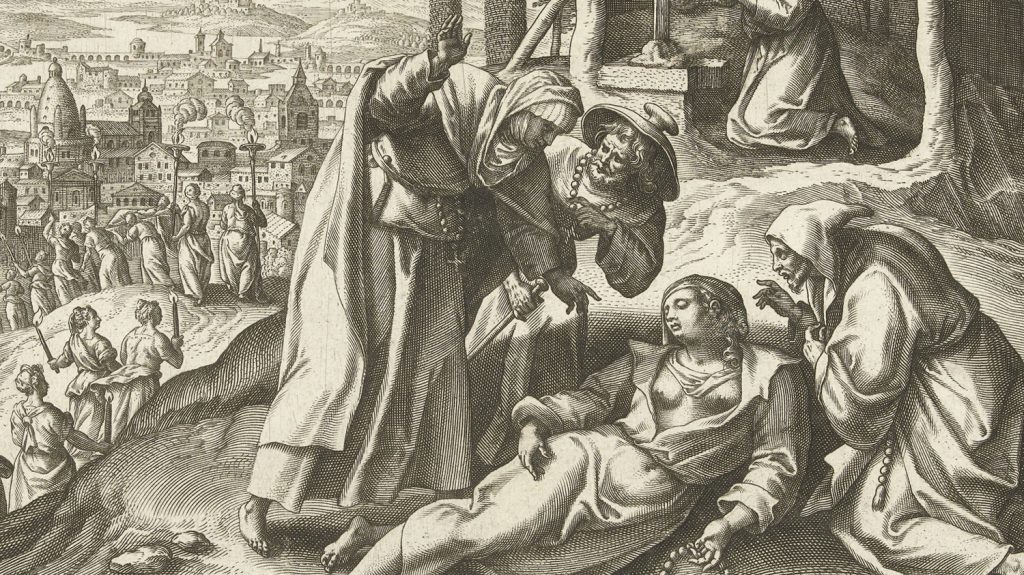
It is St Pelagia’s Day. Pelagia was originally named Margarita, and was a beautiful and famous actress of 4th or 5th century Antioch. She went about the streets in a dazzling display of jewels, pearls and gold accessories, but one day she heard the preaching of Nonnos, a devout monk-bishop, and was converted, which Nonnos had already foreseen in a dream. Once she was baptized, she took herself beyond temptation by living in a small cell on the Mount of Olives dressed as a man and answering to the name of Pelagius. After she died, her identity as a woman was discovered (above), and she was renamed Pelagia. The future patron saint of crossdressing.
‘I saw the dove again, covered grievously with filth, and again it fluttered around me. Then I held out my hands and drew it to me, and plunged it into the font which was in the ante-chamber of the holy church and washed off all the dirt with which it was covered and it came out of the water as white as snow. It flew up into the highest heaven and was lost to my sight.’ Dream of Nonnos in The Life of St Pelagia the Harlot, translated by Sr Benedicta Ward, SLG
John Lennon’s album Imagine was released in the UK today in 1971. The title track, written by John Lennon and Yoko Ono, was a hymn to utopian simplicity, dispensing with heaven, hell, countries, religion and, er, possessions, of which John and Yoko had plenty.
Robert Grosseteste, one of the most brilliant minds of the Middle Ages, died today in 1253. He was an early chancellor of Oxford University, as well as being Bishop of Lincoln, and his work as a scientist, theologian, philosopher, pastoral leader and intellectual had a profound influence on scientific thought and philosophy.
The Council of Chalcedon opened today in 451. With 500-600 bishops, it was largest church council until the First Vatican Council of 1869, and it was called by Empress Pulcheria to sort out once and for all who Jesus was – or at least who he was not. Disagreeing with four main schools of thought, the Council declared that Jesus is totally God, yet totally human; and the human and divine parts weren’t separate, but neither were they merged into a hybrid.
Brigham Young, who succeeded Joseph Smith as President of the Church of Latter Day Saints (the Mormons), married his first wife, Miriam Angeline Works, today in 1824. By the time he died in 1877, it is thought he had a further 54 wives.
Alexandr Solzhenitsyn, the Russian novelist and dissident, won the Nobel Prize in literature today in 1970.
‘Archaeologists have not discovered stages of human existence so early that they were without art. Right back in the early morning twilights of mankind we received it from Hands which we were too slow to discern. And we were too slow to ask: for what purpose have we been given this gift? What are we to do with it?’ Alexandr Solzhenitsyn, Nobel Lecture, 1970
Image: Rijksmuseum